
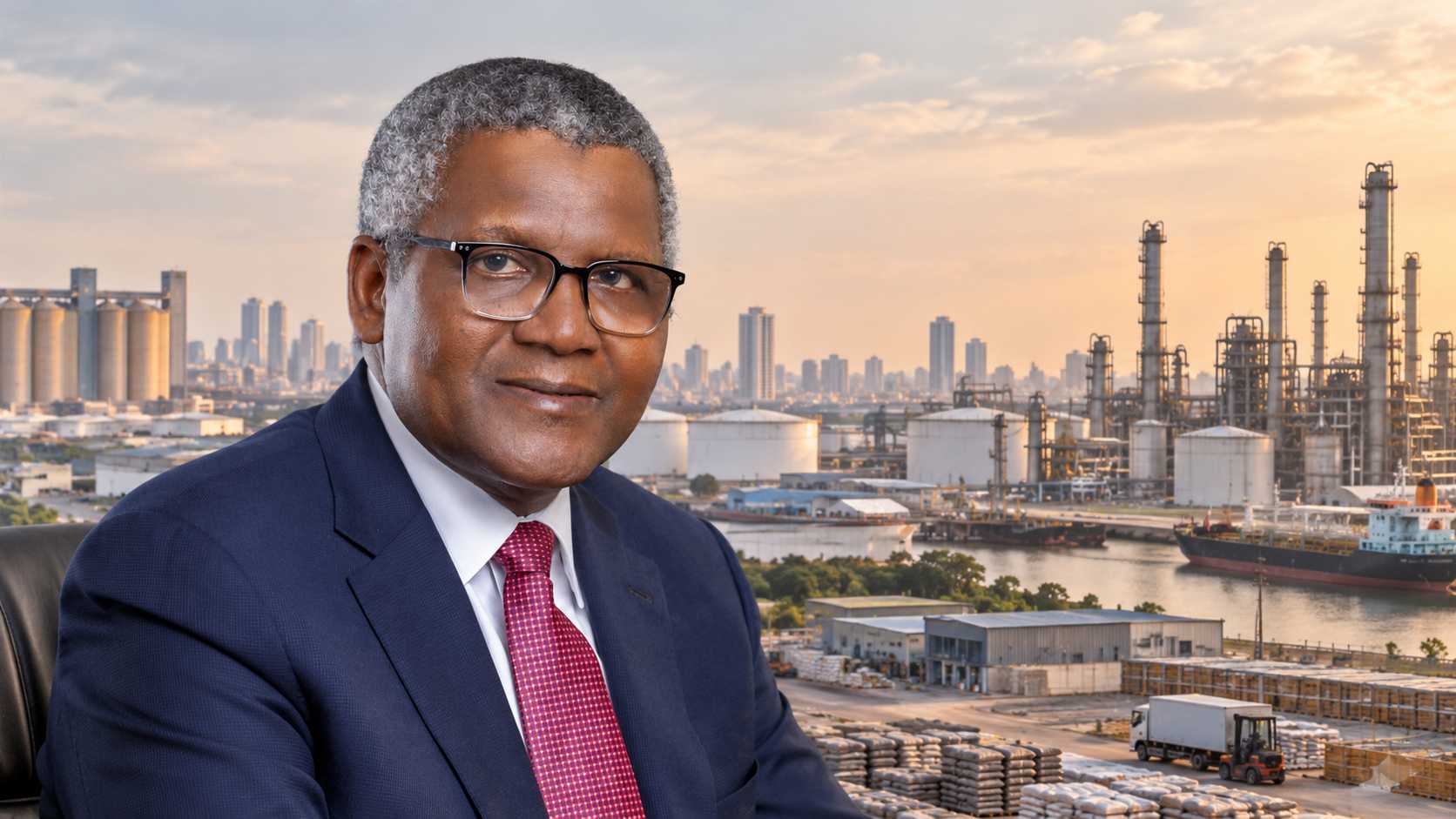
Aliko Dangote has spent much of his career betting that Africa should manufacture more of the products it buys from overseas. Cement made him a billionaire. Sugar and fertilizer helped expand his business empire. Then came a $20 billion oil refinery that even experienced investors doubted he could finish.
By 2026, that refinery was making billions in profit, selling fuel to international markets and helping push Dangote into a new league of global wealth. Forbes valued his fortune at $28.5 billion in March 2026, with later estimates rising sharply as the market reassessed his petroleum business.
At 69, the Nigerian businessman has become one of the most influential industrial figures in Africa. His companies supply materials used to build homes, produce food and keep vehicles running. Yet his journey began with something far smaller, a trading business selling imported goods in Lagos.
Growing Up in a Family That Knew Business
Born on April 10, 1957, in Kano, Nigeria, Dangote grew up surrounded by successful merchants. His grandfather, Sanusi Dantata, had built considerable wealth through trading, and business was part of everyday family life.
Dangote has recalled buying sweets as a child and asking other children to sell them, keeping the profits. The story offers an early glimpse of his commercial instincts, although he did not begin his career without financial advantages.
He studied at Al-Azhar University in Cairo before returning to Nigeria to pursue business. In 1977, he moved to Lagos and entered commodity trading with financial support from his family.
His early products were hardly glamorous. Cement, rice, sugar and flour were already in demand, and he concentrated on supplying customers who needed them.
According to the history of Dangote Cement, the business established in 1981 initially imported bagged cement and other commodities before gradually developing into a manufacturing group.
For years, buying imported goods and distributing them across Nigeria generated the money that would support his bigger ambitions.
View this post on Instagram
The Decision That Changed Everything
Dangote could have remained a successful importer. Instead, he began investing in factories that would produce the cement his company had previously purchased from overseas.
Nigeria offered an enormous potential market. Growing cities needed homes, businesses needed commercial buildings, and governments were investing in roads and public infrastructure.
During the early 2000s, Dangote acquired cement assets and financed new production facilities. His Obajana cement plant in Kogi State opened in 2007 with an initial annual capacity of five million tonnes. At the time, it was the largest cement factory in sub-Saharan Africa.
Building the facility demanded far more money than importing and reselling cement. Dangote had to secure limestone, machinery, electricity, transportation and workers. Once production began, however, his company could manufacture cement locally and distribute it through an expanding network.
The strategy eventually reached other African countries. Factories and distribution operations opened in markets including Ethiopia, Senegal, Tanzania and South Africa.
Africa has produced other influential business leaders, including South African entrepreneur Jabu Mabuza, who became a prominent figure in the country’s corporate and energy sectors.
By 2025, Dangote Cement operations had reached 11 African countries, with total annual production capacity of up to 55 million tonnes. The company reported revenue exceeding $3 billion that year.
Cement remains central to his personal fortune. Dangote owns an estimated 85% of the publicly traded company through a holding company, giving him enormous exposure to its financial performance and share price.
Expansion Into Sugar, Salt and Fertilizer
View this post on Instagram
After establishing a major cement business, Dangote continued investing in products with established demand across Nigeria.
Sugar was a natural extension of his earlier trading activities. His group had experience importing the product, and Nigeria had a large market among households and food manufacturers.
Dangote Sugar Refinery developed into one of the largest businesses of its kind in Africa. Its Apapa facility in Lagos has an installed annual refining capacity of 1.44 million tonnes, according to the company’s published operating information.
The group also invested in domestic sugarcane cultivation, attempting to reduce reliance on imported raw sugar. Producing more of the raw material locally could give the company greater control over future supply costs, although agricultural development requires land, irrigation and years of investment.
Salt production became another part of the empire through NASCON Allied Industries. Meanwhile, Dangote invested heavily in fertilizer manufacturing, connecting his industrial interests to agriculture.
His fertilizer plant began operations in March 2022, creating another source of revenue from products sold to farmers and international buyers. Unlike cement, which depends heavily on construction activity, fertilizer serves agricultural markets with their own seasonal and economic conditions.
Each expansion brought additional costs and exposure to new industries. Dangote was willing to commit large amounts of capital because he saw opportunities to manufacture products that African economies were already purchasing.
The $20 Billion Refinery That Took His Ambitions Further
For decades, Nigeria faced an uncomfortable contradiction. It was a major crude oil producer, yet it relied heavily on imported petrol and other refined fuels.
Dangote believed a large private refinery could change that arrangement. Construction began in 2016 on a massive industrial site near Lagos, but the project became far more difficult and expensive than initially expected.
India’s Reliance Industries offers another example of an industrial group built around large-scale petroleum investments, with the Ambani family, including Anant Ambani, closely associated with its development.
Developing the complex required extensive land preparation, imported equipment, storage facilities and supporting infrastructure. Financing became another challenge as construction costs increased.
The refinery finally began processing crude oil in early 2024. Its original design capacity was 650,000 barrels per day, and production increased as the plant worked through its initial operating difficulties.
By June 2026, the facility had processed 700,000 barrels per day during a performance test, according to a Reuters report on refinery output.
Petrol, diesel and aviation fuel produced at the plant began reaching buyers in Nigeria and overseas. International demand increased during disruptions to Middle Eastern energy supplies, giving the refinery access to markets that would once have looked difficult to enter.
In October 2026, Reuters reported a $4.73 billion profit for the first nine months of the year, compared with a $117.2 million loss during the same period in 2025. The results were unaudited but demonstrated how quickly the financial position of the refinery had changed.
Dangote was also preparing to bring outside investors into the business through a public share offering. A successful listing would provide another market-based valuation for an asset that had consumed years of investment.
Running an Industrial Empire Comes With Enormous Costs
Large factories attract attention when they open, but keeping them operating is an expensive daily responsibility. Cement plants need constant supplies of limestone and fuel. Refineries depend on complex machinery, and every major facility relies on transport networks.
Dangote Cement is a great example. Its operations in Nigeria require fleets of trucks to carry finished cement to distributors and construction sites. Transport interruptions can quickly affect deliveries, particularly when factories serve customers hundreds of kilometres away.
Why Equipment Maintenance Deserves More Attention
Vehicle fleets supporting mining and manufacturing operations need regular servicing, reliable replacement components and access to repairs. A broken truck can leave valuable materials stranded, and delays become more expensive when spare parts must travel long distances.
Companies operating large commercial fleets can reduce interruptions by keeping accurate vehicle records, identifying frequently replaced components and planning purchases before equipment fails.
Working with a genuine parts supplier is one way industrial operators can source original automotive components for trucks, utility vehicles and heavy equipment.
For facilities operating in remote areas, the ability to receive replacement parts is especially important. A maintenance team with the correct components can return equipment to service without waiting for an overseas shipment to arrive.
Industrial businesses also face significant electricity and financing expenses. In Nigeria, currency movements and the cost of imported machinery can add pressure to operating budgets. Owning factories creates opportunities for large profits, but their costs continue even during periods of weaker demand.
Aliko Dangote Net Worth in 2026?

Pinning down his exact fortune is difficult because his wealth is tied to business valuations rather than a fixed amount of cash.
In its latest ranking of Africa’s richest people, Forbes estimated his net worth at $28.5 billion.
However, estimates can change quickly when analysts revise the value of privately held assets or when publicly traded shares move.
His cement holdings remain a major source of wealth, but petroleum refining has become increasingly influential in calculating his financial position.
More importantly, a billionaire valuation does not mean Dangote has the equivalent amount sitting in a bank. Most of his fortune represents ownership in companies, and converting large holdings into cash would involve selling assets and potentially affecting their value.
The Risks Behind Growing Influence
Dangote has benefited from building major businesses in industries where production facilities are expensive and difficult to establish. Yet the same concentration of industrial power has attracted criticism.
Competitors have questioned the influence of his companies, particularly in cement and petroleum refining. Government policies involving imports, industrial protection and market regulation have also generated controversy.
The refinery faces a significant challenge securing enough crude oil at competitive prices. A Reuters investigation into crude supply in August 2026 found that investors were closely examining the cost and reliability of feedstock as Dangote pursued further expansion.
His success also raises questions about what happens when so much business influence rests with one individual. Dangote has increasingly involved experienced executives and family members in managing the group, but the long-term succession of his industrial empire remains an important issue.
The Bottom Line
At an age when many business founders have retired, Dangote is planning another substantial phase of expansion.
His group has announced plans to increase refining capacity and pursue additional industrial investments.
In September 2026, Reuters shared a story about a $14.3 billion refinery expansion plan intended to raise capacity to 1.4 million barrels per day by 2029.
Another proposed refinery in East Africa has also attracted attention, although securing crude oil and financing would present major challenges.
Few entrepreneurs have influenced Nigerian manufacturing as much as Dangote. He began by selling imported cement and eventually built factories capable of supplying customers across Africa. His petroleum investment has extended that reach into international energy markets.
The next chapter of his career will depend on how well those businesses perform after the excitement surrounding their construction fades. Profitable factories, reliable supplies and manageable debt will determine how much of his extraordinary fortune he can preserve and pass to the next generation.
