
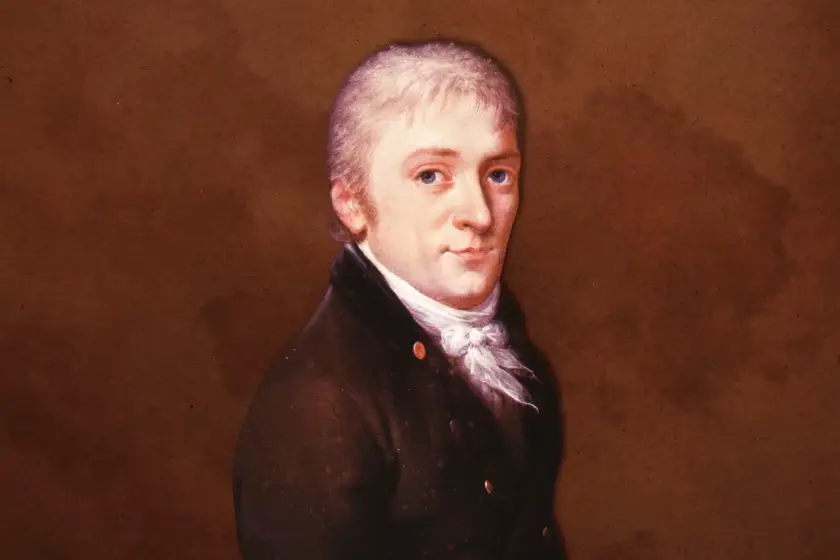
Carl Friedrich Gauss was born on April 30, 1777, in Brunswick, Germany. His family wasn’t wealthy or scholarly – his father was a laborer with jobs ranging from gardener to treasurer, and his mother was an illiterate housemaid.
But young Carl? He had something nobody could teach: raw genius. There’s a story, told so often it’s practically a legend, that at just three years old, Gauss corrected a mistake in his father’s arithmetic.
By five, he was keeping the household books. And at seven, when his teacher asked the class to add the numbers from 1 to 100, Gauss stunned everyone by solving it in seconds.
He’d spotted the trick: 1 + 100 = 101, 2 + 99 = 101, and so on, making 50 pairs of 101. Total? 5,050. His talent was impossible to ignore. With the help of his teacher Johann Bartels and a supportive mother, Carl’s brilliance reached the ears of the Duke of Brunswick.
The Duke funded his education, first at the Collegium Carolinum, then at the University of Göttingen. It was there, even before finishing his degree, that Gauss began reshaping mathematics as we know it.
Early Discoveries That Shaped Mathematics

By 19, Gauss had already pulled off what many thought impossible: he showed how to construct a regular 17-sided polygon using only a compass and straightedge.
It sounds obscure, but for mathematicians, it was earth-shaking, a problem unsolved since the days of the Greeks. This was just the beginning.
Disquisitiones Arithmeticae
At 24, Gauss published Disquisitiones Arithmeticae, written in Latin and packed with ideas that would define number theory for centuries.
He introduced modular arithmetic, an elegant way to work with remainders, and formalized the law of quadratic reciprocity, which deals with how numbers relate when squared.
To this day, the book is treated like a sacred text in number theory. For those looking to deepen their understanding of such techniques, see resources on mathematical analysis.
The Fundamental Theorem of Algebra
His doctoral thesis, completed at the University of Helmstedt in 1799, did what no one else had done convincingly: it proved the fundamental theorem of algebra.
That’s the rule stating that every polynomial equation has a number of complex roots equal to its degree. Gauss was so dedicated to this idea that he offered three more proofs over the years, refining his work every time.
Complex Numbers and Geometry
He also helped shape how we think about complex numbers, the mysterious combo of real and imaginary numbers. Thanks to Gauss, their notation became standardized, and they became central to many areas of physics and engineering.
In geometry, he made a leap with the concept of Gaussian curvature, a way to describe how surfaces bend in space. His theorema egregium (literally, “remarkable theorem”) showed that the curvature of a surface is something intrinsic, not dependent on how the surface is laid out in space.
That revelation was key to later advances in geometry and even Einstein’s theory of relativity.
Astronomy, Physics, and the Power of Applied Math
Rediscovering Ceres
In 1801, astronomers lost track of a newly discovered asteroid named Ceres. While others were guessing, Gauss developed a new statistical method, the method of least squares, to predict its location. He nailed it.
Ceres was found right where he said it would be. The method is still used today in everything from satellite positioning to machine learning.
Theoria Motus and Orbit Calculations
Gauss followed up with Theoria motus corporum coelestium, a book that explained how to calculate the orbits of celestial bodies. He didn’t just theorize; he provided tools that made astronomy more precise.
The Hanover Project
View this post on Instagram
Between 1818 and 1832, Gauss led a massive geodesic survey of the Kingdom of Hanover. To improve accuracy, he invented a device called the heliotrope that reflected sunlight to create precise sightlines over long distances.
His work wasn’t just about mapping terrain; it fed directly into his work on curvature and surfaces.
Magnetism and Electromagnetism
In the 1830s, Gauss teamed up with Wilhelm Weber to explore magnetism. They built one of the first magnetometers and conducted a global survey of Earth’s magnetic field.
They even invented an early telegraph that used binary code, laying the groundwork for later developments in communication.
Gauss also articulated what’s now called Gauss’s Law, which describes how electric fields relate to the charges that produce them. It’s a core part of Maxwell’s equations, formulas that underlie all of classical electromagnetism.
Personal Life
In 1805, Gauss married Johanna Osthoff. Their life together was short but deeply important to him. She died in 1809 shortly after giving birth to their third child. Gauss was devastated.
He remarried the following year to Johanna’s close friend, Minna, and had three more children. Family tragedies left scars. One of his sons moved to America after a falling-out. Gauss never followed him, unwilling to leave Göttingen, which he called home for nearly five decades.
He kept his circle small, his publications limited, and his lectures rare. Gauss preferred to work in silence and release only what he thought was perfect. That meant some of his most revolutionary ideas, like his notes on non-Euclidean geometry, stayed private for years.
Disputes, Influence, and the Weight of Genius
Gauss’s legacy is packed with accomplishments, but there were tensions, too. He had an especially complicated reaction to the work of János Bolyai, a Hungarian mathematician who independently developed non-Euclidean geometry.
Rather than celebrate the breakthrough, Gauss reportedly said it wouldn’t surprise him because he’d already thought of it himself. Bolyai, disheartened, left mathematics. Some saw Gauss’s comments as egotistical.
Others believe he was cautious about promoting radical ideas in a conservative academic environment. Either way, it’s clear that his silence kept the field from advancing sooner.
Still, the names tied to his influence read like a who’s who of mathematical history: Riemann, Dedekind, Lobachevsky, Weber. Many of his students and collaborators carried forward his methods and mindset, building entire disciplines from his foundations.
Where You Still Find Gauss Today
If you’ve taken a math class, used GPS, or run data through a regression model, you’ve brushed up against Gauss’s work. Here’s where his influence shows up today:
| Field | Gauss’s Contribution | Real-World Use |
| Number Theory | Modular arithmetic, quadratic reciprocity | Cryptography, blockchain technology |
| Statistics | Method of least squares | Data fitting, machine learning, economics |
| Physics | Gauss’s Law, magnetism research | Electrical engineering, field theory |
| Astronomy | Orbit prediction techniques | Planet tracking, satellite guidance |
| Geometry | Gaussian curvature, differential geometry | 3D modeling, general relativity |
| Communication | Binary-coded telegraph with Weber | Foundations of digital communication systems |
Even the term “Gaussian distribution,” more commonly known as the bell curve, is named for him. It describes how things like IQ scores, height, and test results tend to spread out in populations. In short, his fingerprints are everywhere.
End of Life and Final Wishes
Gauss passed away in 1855, quietly and peacefully in his sleep. He’d spent his later years focused on finance (he managed the Göttingen widow’s fund with a mathematician’s precision) and personal study.
He gave one final scientific opinion in 1854, on a version of the Foucault pendulum experiment. In his will, he requested a 17-sided polygon carved into his gravestone, commemorating his earliest mathematical victory.
The stonemason refused. Said it was too hard. Instead, you can find the heptadecagon on a memorial in his hometown of Brunswick. His brain, preserved for scientific study, still resides at the University of Göttingen.
Not out of morbidity, but reverence. A mind that brilliant left a mark that even time can’t erase.
Why Gauss Still Matters
@mrmathblog Carl Friedrich Gauss #carlgauss #carlfriedrichgauss #addingnumbers #mrmathblog #mathhelp ♬ original sound – mrmathblog
Carl Friedrich Gauss wasn’t a flashy public figure. He didn’t crave recognition or headlines. What he wanted was clarity, precision, and elegance in thought. And he got it-again and again.
His contributions aren’t just important because they were correct. They’re important because they built a new way of thinking. He taught us that even the messiest parts of life: motion, error, shape, light, can be understood with structure and beauty.
It’s no surprise that number theory and abstract algebra, two areas rooted in Gauss’s legacy, are among the most failed courses at UC Berkeley—proof that his path demands focus and discipline.
We live in a world shaped by Gauss. From the curves of our satellites’ paths to the algorithms in our phones, his ideas keep ticking quietly in the background.
He once said, “Mathematics is the queen of the sciences, and number theory is the queen of mathematics.” If that’s true, then Gauss was more than just her prince. He was the architect of her kingdom.
