
The athletic apparel giant stands as a dominant force in global sports retail. Since its founding in 1964, this Oregon-based corporation has built an iconic identity recognized worldwide.
Headquartered in Beaverton, the company achieved remarkable financial results in fiscal year 2023. Revenue reached $51.21 billion with net income of $5.07 billion. Current CEO John Joseph Donahoe leads approximately 83,700 employees.
This strategic examination provides valuable insights into the organization’s current market position. The framework evaluates internal capabilities and external market forces. Understanding these factors helps stakeholders anticipate future challenges and opportunities.
The brand’s diverse portfolio includes footwear, apparel, athletic equipment, and accessories. Major competitors like Adidas, Under Armour, and Puma create a dynamic competitive landscape. The iconic swoosh logo symbolizes victory and athletic achievement.
Introduction to Nike SWOT Analysis
What started as a partnership between an athlete and his coach has evolved into one of the world’s most valuable brands. This section explores the corporation’s journey and current standing.
Company Background and History
The corporation began in 1964 as Blue Ribbon Sports. University of Oregon track athlete Phil Knight and coach Bill Bowerman founded the company. They initially imported Japanese athletic shoes.
The business rebranded as Nike in 1967 after developing the successful Tiger Cortez model. A design student named Carolyn Davis created the iconic swoosh logo for just $35.
The 1980 initial public offering transformed the founder into a millionaire. Over the years, the organization grew from a small distributor to a global powerhouse.
Market Position and Brand Overview
Today, the brand maintains a dominant position in the athletic wear industry. Interbrand ranks it #9 globally with a $53.7 billion valuation.
The company’s market capitalization reached $142.2 billion in March 2024. It operates in over 190 countries with offices in 49 nations.
Headquartered in Beaverton, Oregon, the corporation employs thousands worldwide. This extensive reach supports its competitive market position.
Nike SWOT Analysis
Business evaluation tools help stakeholders understand organizational positioning. This framework examines internal capabilities and external market forces. It provides actionable insights for strategic planning.
Defining the Analysis Framework
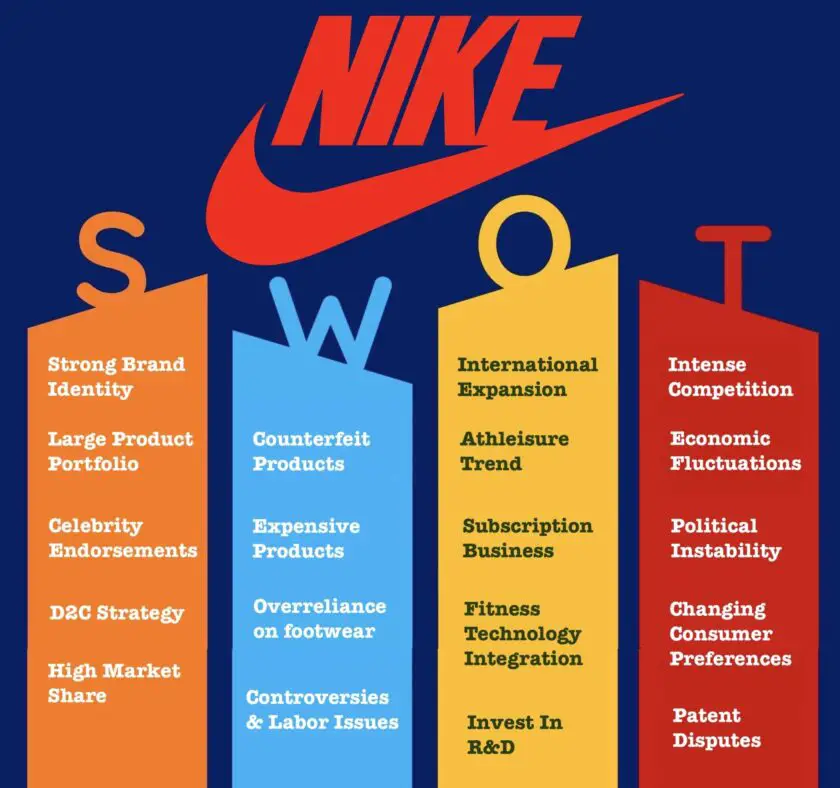
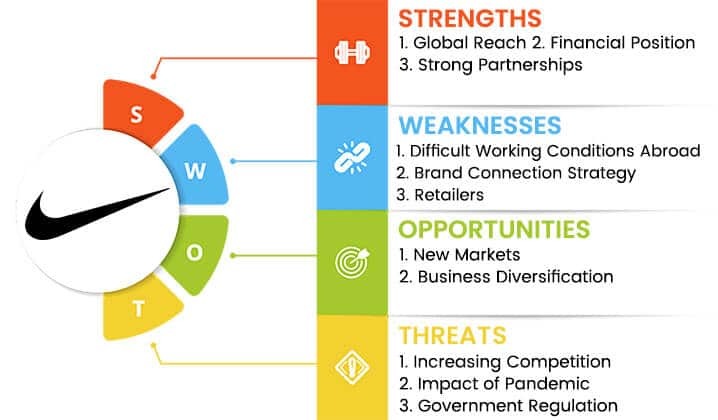
The SWOT methodology breaks down into four key components. Strengths and weaknesses represent internal factors within the company’s control. Opportunities and threats come from external market conditions.
This approach creates a balanced view of corporate performance. It helps identify areas for improvement and potential growth paths. The framework supports data-driven decision making.
Key Metrics and Data Points
Several indicators will guide this business assessment. Market share data shows competitive positioning. Financial performance metrics reveal operational efficiency.
Brand value measurements assess marketing effectiveness. Supply chain metrics evaluate production capabilities. These data points come from authoritative industry sources.
The analysis considers both current performance and future potential. It acknowledges the framework’s limitations while highlighting valuable insights. This balanced approach supports comprehensive understanding.
Nike’s Strengths and Competitive Advantages
Multiple authoritative sources consistently rank the brand among the world’s most valuable, with valuations ranging from $33.2 billion to $109 billion. These impressive numbers reflect the corporation’s powerful market position.
Strong Brand Recognition and Iconic Logo
The instantly recognizable swoosh symbol represents athletic achievement worldwide. This visual identity contributes significantly to the company’s strong brand presence across global markets.
Market dominance is evident in the 39% share of athletic footwear and 13% of apparel sectors. Millions of loyal customers support a market capitalization exceeding $142 billion.
Strategic Athlete Endorsements and Partnerships
The company’s partnership strategy with elite athletes has generated remarkable returns. The Michael Jordan collaboration created the legendary Air Jordan line.
This partnership exceeded expectations, generating $126 million in its first year alone. Today, lifetime deals with stars like Jordan, Ronaldo, and James exceed $1 billion each.
| Athlete | Partnership Value | Key Product Line | Years Active |
|---|---|---|---|
| Michael Jordan | $1.3+ billion | Air Jordan | 1984-present |
| Cristiano Ronaldo | $1+ billion | CR7 Collection | 2003-present |
| LeBron James | $1+ billion | LeBron Series | 2003-present |
“The synergy between elite athletic performance and brand identity creates an unstoppable market force that resonates with consumers globally.”
With $4.06 billion annual marketing investment and 650+ sponsorships, these strengths create a self-reinforcing advantage. The powerful brand image attracts top talent, which further enhances market position.
This comprehensive approach to building competitive advantages makes the company a subject of frequent strategic business analysis among industry experts.
Analyzing Nike’s Weaknesses and Operational Challenges

The company’s global success masks several persistent challenges that could impact future performance. These operational weaknesses require ongoing management attention.
Labor Conditions and Outsourced Manufacturing Issues
Serious labor conditions concerns have plagued the corporation for over two decades. Allegations include forced labor, child labor, and unsafe working conditions in overseas facilities.
A 2020 report revealed disturbing manufacturing practices involving Uyghur workers in China. Production remains concentrated in Vietnam (50%), Indonesia (27%), and China (18%).
This geographic concentration creates quality control challenges and geopolitical risks. The heavy reliance on outsourced manufacturing represents significant operational weaknesses.
Dependency on Retail Partners and Domestic Market
The retail strategy creates another vulnerability for the company. Fifty-six percent of products move through wholesalers and retailers.
This gives intermediaries stronger pricing power and reduces control over customer experience. The dependency on retail partners limits direct brand engagement.
Financial obligations include $8.9 billion in long-term debt as of fiscal year 2023. North America accounts for 44% of sales, creating market concentration risk.
Legal challenges, including gender discrimination lawsuits, further damage the employer brand. These factors combine to create vulnerabilities that competitors could exploit in any strategic business analysis.
Opportunities for Innovation and Global Growth
Innovation-driven initiatives open doors to unprecedented growth in both physical and digital realms. The company faces multiple expansion opportunities across global markets. Strategic moves position it for significant business development.
Emerging Markets and International Expansion
Rising middle classes in countries like India, China, and Brazil create expanding customer bases. These markets offer substantial growth potential for athletic brands. Local adaptation of products can drive deeper market penetration.
International expansion represents a key opportunity for market share growth. Underpenetrated regions around the world await strategic entry. Cultural customization of offerings can accelerate acceptance.
| Market Region | Growth Potential | Key Challenges | Strategic Focus |
|---|---|---|---|
| Asia-Pacific | High | Local competition | Digital-first approach |
| Latin America | Medium-High | Economic volatility | Affordable premium segment |
| Middle East | Medium | Cultural adaptation | Luxury and performance |
Digital Transformation and Technological Integration
Strategic acquisitions like Celect and RTFKT enhance digital capabilities. These moves support the company’s direct-to-consumer strategy. Online sales already account for 44% of revenue.
The exit from wholesale distribution in the U.S. doubles profit margins. This creates significant opportunities for enhanced customer experience. Digital platforms enable personalized engagement worldwide.
Metaverse initiatives through RTFKT acquisition open new revenue streams. Virtual product development represents frontier opportunities. These technological integrations support comprehensive strategic planning for future growth.
Threats and External Risks Impacting Nike
The global business environment contains multiple risk factors that threaten the company’s continued growth trajectory. These external pressures require vigilant monitoring and strategic responses.
Counterfeit Products and Patent Disputes
Fake merchandise represents a significant threat to revenue and brand integrity. Low-quality counterfeit products flood markets worldwide.
These imitation goods damage consumer perception of quality. They also divert sales from legitimate channels.
Legal battles over technology patents consume substantial resources. Conflicts with competitors over shoe designs create additional challenges.
| Threat Category | Impact Level | Primary Regions | Key Challenges |
|---|---|---|---|
| Counterfeit Products | High | Global markets | Brand reputation damage |
| Patent Disputes | Medium | US, Europe | Legal costs and exposure |
| Economic Volatility | High | All countries | Currency fluctuations |
| Trade Tensions | Critical | China, US markets | Supply chain disruption |
Economic Uncertainty and Trade Tensions
Global economic instability poses serious threats to profitability. Currency fluctuations affect earnings reported in US dollars.
Trade conflicts between major markets create supply chain vulnerabilities. These tensions impact the company’s two largest markets directly.
Industry analysts highlight these external factors in their strategic assessment of market risks.
Financial Performance and Market Trends
Market capitalization and quarterly results provide critical insights into investor confidence and business momentum. The corporation’s financial metrics demonstrate robust operational efficiency across global markets.
Revenue Growth and Investment Insights
Fiscal year 2023 saw impressive revenue of $51.21 billion with net income reaching $5.07 billion. This performance reflects strong sales generation and profitability across the company’s diverse product portfolio.
The quarter ending February 29, 2024, continued this momentum with $12.429 billion in revenue. Digital growth accelerated significantly, with the brand achieving 24% expansion in online channels.
Nike.com attracted over 124 million visits in March 2024, with American visitors comprising 36.95% of traffic. This digital transformation represents a fundamental shift in the business model.
Online sales accounted for 44% of total revenue in fiscal year 2023. The company’s $4.06 billion marketing investment demonstrates commitment to brand building and customer acquisition.
Geographic distribution shows North America contributing 44% of sales. With 1,032 retail stores worldwide and 83,700 employees, the corporation maintains extensive global operations supporting its market position.
Sustainability, Ethics, and Corporate Responsibility

Corporate responsibility initiatives represent a critical dimension of modern business strategy. The company faces increasing pressure to balance environmental stewardship with commercial objectives. This creates complex challenges for brand management worldwide.
Move to Zero and Environmental Initiatives
The “Move to Zero” campaign pledges 100% renewable energy across all facilities. This ambitious environmental program targets net-zero carbon emissions globally. However, the company’s innovation-first approach sometimes conflicts with sustainability goals.
Recent manufacturing changes include eliminating kangaroo leather from shoe production. This decision reduces impact on endangered species populations. Synthetic alternatives demonstrate commitment to more eco-friendly methods.
Social responsibility efforts include the “Don’t Do It” advertising campaign. This initiative supported Black communities against racial injustice. Such public stands can strengthen brand image when authentic.
Persistent ethical challenges surround labor conditions in supply chains. Criticism includes forced labor, child labor, and inadequate wages. A 2020 report revealed Uyghur forced labor in Chinese facilities.
Growing consumer environmental consciousness creates both pressure and opportunity. The company must demonstrate genuine commitment beyond marketing statements. Effective corporate responsibility frameworks require alignment between public commitments and operational realities, as explored in comprehensive business ethics research.
Digital Transformation and Consumer Direct Strategy
Digital transformation has fundamentally reshaped how athletic brands connect with consumers. The corporation’s strategic pivot began with the 2017 Consumer Direct Offense initiative.
This five-year plan shifted focus toward direct sales channels. It prioritized relationships with 40 key retail partners while expanding owned digital platforms.
E-commerce Expansion and Direct Sales Approach
The business systematically reduced wholesale dependencies starting in 2020. This included ending the Amazon pilot program to control brand experience.
Online sales now represent 44% of total revenue. Digital channels surged 82% during fiscal year 2020, accelerating consumer adoption.
Strategic acquisitions enhanced digital capabilities. Zodiac, Celect, and Invertex improved customer analytics and demand sensing.
Enhancing Customer Engagement Digitally
The 2020 Consumer Direct Acceleration created a connected marketplace. This strategy delivers seamless experiences across all touchpoints.
Headless e-commerce architecture provides flexibility for rapid testing. Decoupling front-end and back-end systems enables personalized customer interactions.
Nike.com attracted 124 million visits in March 2024 alone. This demonstrates strong digital engagement with the brand’s products and services.
Innovation and Research: Product Development and R&D
Advanced prototyping techniques form the foundation of the company’s product quality and design excellence. The organization maintains world-class research facilities dedicated to pushing boundaries in athletic performance.
Cutting-edge Design and Prototyping Techniques
The LeBron James Innovation Center represents the epicenter of breakthrough product development. This 700,000-square-foot facility houses over 700 innovation professionals working on next-generation sports products.
The Nike Sport Research Lab occupies 84,000 square feet with extraordinary testing capabilities. Researchers utilize 400 motion-capture cameras and 97 force plates to analyze athletic movement.
An in-house team of designers follows a philosophy of endless prototyping without constraints. This approach enables thorough research and development that drives sustained business success.
Substantial R&D investments keep the company ahead of consumer preferences. The organization ranked 12th on BCG’s 2022 most innovative companies list.
Groundbreaking innovations like the Vaporfly running shoes prompted World Athletics to issue new technology guidelines. Patent disputes over Flyknit technology demonstrate the company’s commitment to protecting intellectual property.
Global Supply Chain and Strategic Partnerships

Strategic partnerships with elite performers create powerful market advantages for sports companies. These collaborations extend beyond individual athletes to include manufacturing networks and distribution channels.
Efficient Manufacturing and Supply Chain Management
The corporation’s manufacturing footprint spans multiple countries with Vietnam handling 50% of production. Indonesia contributes 27% while China accounts for 18% of output.
Additional facilities operate in Argentina, Brazil, India, Italy, and Mexico. This geographic diversity helps mitigate regional disruptions.
Reliance on independent manufacturers creates both flexibility and vulnerability. Quality control challenges and ethical concerns persist throughout the supply chain.
Strategic Endorsements and Brand Collaborations
The company maintains over 650 sponsorships across 140 leagues and associations. These partnerships create unmatched visibility in global markets.
Lifetime deals with icons like Michael Jordan exceed $1.3 billion in value. Other highest-paid athletes including Cristiano Ronaldo and LeBron James command similar commitments.
The 2023 exit from wholesale distribution marked a strategic shift. This move away from retail partners like Zappos and Dillard’s prioritizes direct consumer relationships.
Conclusion
The examination of internal capabilities and external market forces paints a picture of resilient industry leadership. This company maintains a dominant position in the global sportswear market through unparalleled brand recognition and strategic marketing.
Despite challenges in manufacturing and retail dependencies, the corporation’s strengths in innovation and customer engagement provide a solid foundation. Growth opportunities in digital transformation and emerging markets offer significant potential for expansion.
The analysis reveals that while facing threats from competition and economic uncertainty, the brand’s quality products and services position it well for future success. Its diverse portfolio of footwear, apparel, and sports equipment continues to resonate with consumers worldwide.
This balanced perspective acknowledges both the company’s achievements and areas requiring ongoing attention. The sportswear industry leader appears well-equipped to navigate evolving market dynamics while maintaining its competitive presence.

I am Lazar Bojic, an established professional in digital marketing with almost a decade of experience. Specializing in an array of niches has been my main strength as a content creator. Besides being a content writer, I have participated in creating various other content types, including infographics and script writing for video content creators, across numerous niches. Among my standout works, content creation at wikibiography.in certainly holds a special place.